
Quick Facts
- Located on the front wall of the vagina approximately 1–2 inches inside
- May be part of the clitorourethrovaginal (CUV) complex
- Best explored when fully aroused
- Not everyone experiences intense G-spot sensitivity
- Combination clitoral and G-spot stimulation often increases pleasure
Introduction
For decades, the G-spot has been one of the most talked-about — and misunderstood — topics in sexual wellness. Some people describe it as the key to deep, full-body orgasms, while others wonder if it even exists. Between conflicting advice, internet myths, and outdated information, it’s no surprise that many vagina owners feel confused about where the G-spot is, what it does, and whether it’s possible to experience a G-spot orgasm.
The good news is that sexual pleasure isn’t about finding a hidden “magic button.” Modern research suggests that what many people call the G-spot is part of the larger clitoral network of highly sensitive tissues that work together during arousal. Every body is unique, and there’s no single “right” way to experience pleasure.
Whether you’re curious about exploring your own body, hoping to experience a G-Spot orgasm for the first time, or looking for new ways to increase intimacy with a partner, understanding your anatomy is the best place to start.
In this guide, you’ll learn:
- What the G-spot is and what science says about it.
- Where the G-spot is located and how to find it.
- Why G-spot stimulation feels pleasurable for many people.
- Step-by-step techniques for solo and partnered exploration.
- The connection between G-spot stimulation, female ejaculation, and squirting.
- Common myths and misconceptions.
- Tips for increasing pleasure using fingers, penetrative sex, and sex toys.
- Answers to the most frequently asked questions about G-Spot orgasms.
Remember that there’s no “normal” way to experience pleasure. Some people love G-spot stimulation, others prefer direct clitoral stimulation, and many enjoy a combination of both. Your experience is valid, whatever it may be.
What Is the G-Spot? Understanding the Anatomy of Pleasure
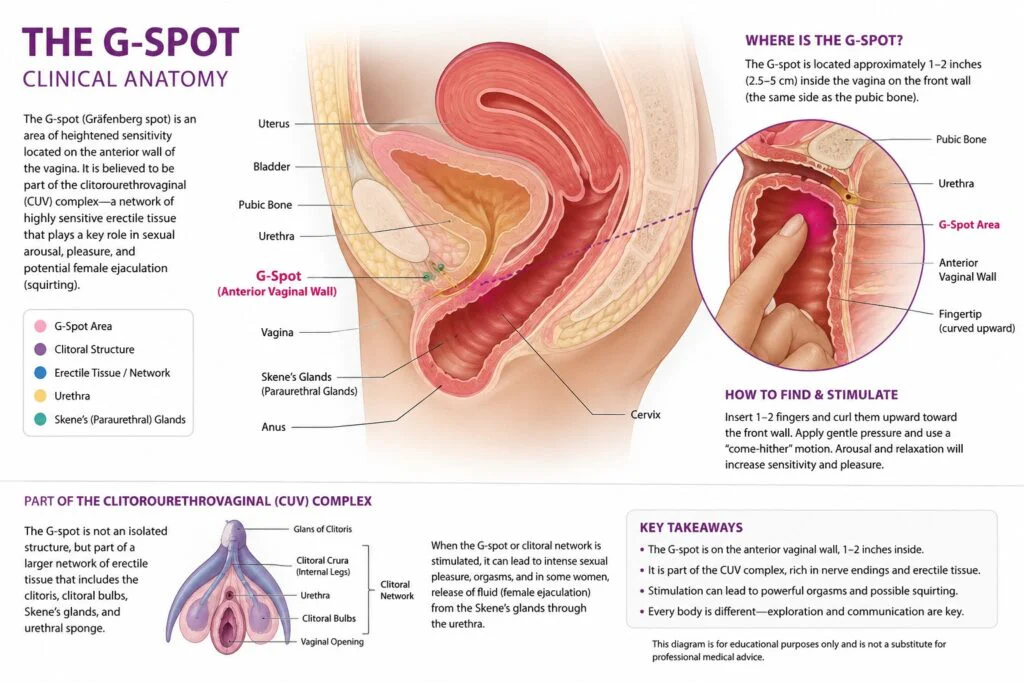
The G-spot is commonly described as an area of heightened sensitivity located on the front (anterior) wall of the vagina, a few inches inside the vaginal opening. Rather than being a distinct organ, many researchers now believe it represents part of a larger interconnected pleasure system known as the clitorourethrovaginal (CUV) complex.
This means the sensations people associate with the G-spot likely result from the interaction between several anatomical structures, including the:
- Internal portions of the clitoris
- Clitoral bulbs
- Urethra
- Surrounding erectile tissue
- Pelvic floor muscles
- Nerve-rich vaginal tissue
When these tissues become engorged during sexual arousal, they can become much more sensitive to pressure and movement.
The Clitoris Is Much Bigger Than You Think
Many people picture the clitoris as the small external glans visible at the top of the vulva. In reality, that’s only the tip of a much larger structure.
The complete clitoral structure extends deep inside the pelvis. Internal branches, sometimes called the “legs” (crura), wrap around the vaginal canal while the clitoral bulbs fill with blood during arousal. Because these internal tissues surround parts of the vagina, stimulation through the vaginal wall may indirectly stimulate portions of the clitoral complex.
This helps explain why many people report different sensations during clitoral, vaginal, and cervical stimulation.
The Clitorourethrovaginal (CUV) Complex
Instead of viewing the G-spot as one isolated anatomical structure, many sexologists and researchers now describe it as part of the clitorourethrovaginal complex.
The CUV complex recognizes that several tissues work together during sexual arousal, including the clitoris, urethra, anterior vaginal wall, and surrounding erectile tissue. Rather than acting independently, these structures form an integrated pleasure network.
This model helps explain why pressure on the front wall of the vagina can produce intense pleasure for some people. Instead of stimulating a separate organ, that pressure may activate multiple sensitive structures simultaneously.
What Does the Science Say?
The existence of the G-spot has been debated for decades.
Some researchers argue there is no single anatomical structure that qualifies as a universal G-spot. Others believe there is a consistently sensitive region within the anterior vaginal wall that deserves recognition.
One influential study from Rutgers University used functional magnetic resonance imaging (fMRI) to examine how the brain responded to different types of genital stimulation. The researchers found that stimulation of the clitoris, vagina, and cervix activated different — but closely related — areas of the brain’s sensory cortex. These findings suggest that vaginal stimulation can produce sensations distinct from clitoral stimulation, even though the structures are closely connected.
At the same time, anatomical studies have struggled to identify one distinct “button” that exists in every person. Because anatomy varies from one individual to another, researchers increasingly emphasize that pleasure is highly personal rather than identical from body to body.
Today, many experts focus less on proving whether a single G-spot exists and more on understanding how the entire clitoral complex contributes to sexual pleasure.
Where Is the G-Spot Located?
If you’ve ever searched online for the G-spot, you’ve probably noticed one recurring theme: everyone seems to describe it a little differently.
That’s because there isn’t one precise location that applies to every body.
For most people, the area associated with the G-spot is found approximately 2–5 cm (1–2 inches) inside the vagina along the front wall — the side closest to the belly button. Unlike the surrounding smooth vaginal tissue, this area may feel slightly firmer, ridged, or textured when the body is fully aroused.
It’s important to remember that this area is often much easier to locate after several minutes of foreplay. During arousal, increased blood flow causes the erectile tissues surrounding the vagina and urethra to swell, making the area more prominent and sensitive.
Without arousal, the tissue may feel almost identical to the rest of the vaginal wall.
How to Find Your G-Spot
Exploring your body should never feel like a test or a treasure hunt. Think of it as an opportunity to discover what feels pleasurable rather than trying to achieve a specific outcome.
Start by creating a comfortable, private environment where you won’t be interrupted. Many people find it helpful to empty their bladder beforehand and use plenty of water-based lubricant to reduce friction.
After becoming aroused through fantasy, erotic media, masturbation, or other forms of foreplay, such as vulva massage, insert one or two well-lubricated fingers into your vagina with your palm facing upward.
Slowly curl your fingers in a gentle “come-hither” motion toward your belly button while applying light to moderate pressure against the front vaginal wall.
Instead of searching for a perfect spot, pay attention to how different areas feel.
You may notice:
- A slightly textured, wrinkled or spongy patch of tissue.
- Increased sensitivity compared to surrounding areas.
- A pleasurable feeling of fullness or pressure.
- An urge to urinate (which is common during early exploration).
- Gradually increasing waves of sexual pleasure.
The sensation often changes as arousal increases, so don’t be discouraged if you don’t notice anything immediately.
Remember, not everyone experiences this area in the same way. Some people find direct G-spot stimulation intensely pleasurable, while others prefer focusing on the clitoris or combining multiple forms of stimulation.
What Is the G-Spot For?
Unlike organs that have a clearly defined biological function, the G-spot isn’t considered a separate anatomical structure with one specific purpose.
Instead, it represents an area where several highly innervated tissues overlap.
When stimulated, these tissues may contribute to:
- Increased sexual pleasure.
- Deeper feelings of fullness during penetration.
- Stronger pelvic floor contractions.
- Female ejaculation for some individuals.
- More intense or blended orgasms.
Some researchers have compared tissue surrounding the urethra to a female prostate because of its similarity to the male prostate gland. These paraurethral glands — sometimes called the Skene’s glands — produce fluid that may contribute to female ejaculation in some individuals.
However, not everyone experiences female ejaculation or squirting, and neither is necessary for satisfying sex or orgasm.
The goal of G-spot exploration isn’t to reach a particular milestone — it’s simply to learn more about your body and discover what brings you pleasure.
A Brief History of the G-Spot
Although the term “G-spot” entered popular culture in the 1980s, the idea itself is much older.
In the 1950s, German gynecologist Dr. Ernst Gräfenberg described an area of heightened sensitivity along the anterior vaginal wall that appeared to respond strongly to pressure during sexual arousal. His observations laid the foundation for what would later become known as the G-spot.
More than three decades later, sex researchers Beverly Whipple, John Perry, and Alice Ladas popularized the concept through their bestselling book The G Spot and Other Discoveries About Human Sexuality. Whipple’s research suggested that stimulating this region could produce powerful orgasms and, in some individuals, female ejaculation.
As interest grew, researchers around the world attempted to identify a distinct anatomical structure responsible for these experiences. While some studies supported the existence of a particularly sensitive area, others failed to find consistent anatomical evidence.
Today, many scientists — including neuroscientist Barry Komisaruk — take a broader view. Rather than focusing on whether one specific “spot” exists, modern research increasingly explores how the clitoris, vagina, urethra, pelvic floor, and surrounding nerves work together to create sexual pleasure.
This shift reflects a growing understanding that human sexuality is wonderfully diverse. Bodies vary, sensations vary, and there is no single roadmap to orgasm.
The G-Spot: Myths vs. Facts
The G-spot has inspired countless magazine articles, television segments, podcasts, videos, and social media discussions over the years. Unfortunately, it’s also become the subject of plenty of misinformation. Separating fact from fiction can help you approach G-spot exploration with realistic expectations and greater confidence.
Myth: Everyone Has a G-Spot and Just Needs to “Find It”
Fact: Every body is different.
While most vagina owners have the same basic anatomy, sensitivity varies from person to person. Some people have a particularly responsive area on the front vaginal wall and can experience intense pleasure or orgasm through G-spot stimulation. Others may notice only mild sensations, or none at all.
This doesn’t mean anything is “wrong” with your body. Just as some people enjoy certain foods or types of touch more than others, sexual preferences and responses are highly individual.
Myth: G-Spot Orgasms Are Better Than Clitoral Orgasms
Fact: There is no hierarchy of female orgasms.
Popular culture often portrays G-Spot orgasms as the “ultimate” sexual experience, but science doesn’t support the idea that one type of orgasm is objectively better than another.
Some people prefer direct clitoral stimulation, while others enjoy internal stimulation or a combination of both. Many describe clitoral orgasms as sharp, focused, and intense, whereas G-Spot orgasms may feel deeper, fuller, and accompanied by stronger pelvic contractions.
Neither experience is superior. The best orgasm is simply the one that feels best for you.
Myth: If You Can’t Have a G-Spot Orgasm, Something Is Wrong
Fact: G-Spot orgasms are only one of many ways to experience pleasure.
Many vagina owners never experience orgasm through vaginal stimulation alone, even after years of enjoyable sexual experiences. Others find that G-spot stimulation becomes more pleasurable with age, increased confidence, or better communication with a partner.
Your body’s response can also vary from one day to the next depending on stress, hormones, arousal, medications, menstrual cycle, and overall well-being.
There is no “normal” way to orgasm.
Myth: G-Spot Stimulation Should Never Feel Uncomfortable
Fact: Gentle pressure may feel unusual at first.
One of the most surprising sensations people report during manual G-spot exploration is a temporary feeling of needing to urinate.
This happens because the G-spot area lies close to the urethra and bladder. As pressure is applied, it can create a sensation that’s unfamiliar until your brain learns to distinguish it from urinary urgency.
If stimulation feels painful, sharp, or persistently uncomfortable, reduce the pressure, add more lube, slow down, or stop altogether. Sexual exploration should never hurt.
Myth: Penetration Alone Is the Best Way to Reach the G-Spot
Fact: Fingers are often more effective.
Although some sexual positions naturally stimulate the anterior vaginal wall, many people find it much easier to locate and stimulate the G-spot using one or two fingers.
Your fingers allow you to adjust pressure, speed, angle, and rhythm much more precisely than penetrative sex alone.
Once you understand what feels pleasurable during manual G-spot exploration, you can recreate similar sensations during partnered sex or with a curved vibrator or dildo.
What Does the Science Really Say?
Although the G-spot remains one of the most debated topics in sexual medicine, researchers agree on several important points.
We know that the front wall of the vagina contains nerve-rich tissue capable of producing pleasurable sensations for many people. We also know that the internal portions of the clitoral structure surround the vaginal canal, allowing pressure from inside the vagina to stimulate parts of the clitoral complex indirectly.
Brain imaging studies have shown that stimulation of the clitoris, vagina, and cervix activates different sensory pathways, suggesting these forms of stimulation can produce distinct experiences.
What scientists continue to debate is whether the G-spot is:
- A single anatomical structure.
- Part of the larger clitorourethrovaginal (CUV) complex.
- A functional area created by multiple interacting tissues.
For most people, the answer doesn’t change how pleasure is experienced.
Whether it’s one structure or several working together, the important takeaway is that many vagina owners can experience significant sexual pleasure from stimulation of the anterior vaginal wall.
What Is Squirting?
Few topics generate as much curiosity — and confusion — as squirting.
Movies and pornography often portray squirting as something that happens effortlessly or during every G-Spot orgasm. In reality, experiences vary tremendously.
Squirting refers to the expulsion of fluid from the urethra during intense sexual arousal or orgasm. Some people squirt frequently, some occasionally, and many never do.
All of these experiences are completely normal.
Research suggests that squirting involves fluid originating primarily from the bladder, although it may also contain secretions from the Skene’s glands, sometimes referred to as the female prostate.
The amount of fluid can range from just a few drops to a much larger release.
Importantly, squirting is not considered proof of orgasm, nor is orgasm required for squirting to occur.
Female Ejaculation vs. Squirting
Although the terms are often used interchangeably, researchers generally distinguish between female ejaculation and squirting.
Female ejaculation usually refers to the release of a relatively small amount of thick, milky fluid produced by the paraurethral (Skene’s) glands. This fluid contains prostate-specific antigens similar to those found in semen.
Squirting typically refers to the release of a larger amount of watery fluid through the urethra during sexual stimulation.
Some people experience one, both, or neither.
Neither response is more “successful” than the other, and neither should be viewed as the ultimate goal of G-spot exploration.
Pleasure — not performance — is what matters.
Can G-Spot Stimulation Help You Squirt?
Possibly — but there are no guarantees.
Many people who squirt report that firm stimulation of the front vaginal wall, combined with high levels of arousal and the ability to fully relax, increases the likelihood.
Several factors appear to contribute:
- Extended foreplay.
- Consistent G-spot pressure.
- Simultaneous clitoral stimulation.
- Relaxed pelvic floor muscles.
- Feeling emotionally safe with a partner.
- Letting go of the fear of making a mess.
One common barrier is resisting the sensation of needing to urinate. Because squirting often begins with a similar feeling, some people instinctively tense their pelvic floor muscles and stop stimulation just as they begin approaching orgasm.
Emptying your bladder beforehand can help you feel more comfortable exploring these sensations.
Remember that squirting is not a measure of sexual ability or pleasure. Many people have incredibly satisfying orgasms without ever squirting.
How to Stimulate Your G-Spot by Yourself
Solo exploration is one of the best ways to discover what your body enjoys. Without the pressure of pleasing a partner, you can experiment with different techniques, speeds, and amounts of pressure.
Step 1: Set the Mood
Choose a time when you won’t be interrupted.
Create an environment that helps you relax. Dim lighting, music, fantasy, erotic literature, or ethical pornography can all help increase arousal if they appeal to you.
The more relaxed you are, the easier it becomes to surrender to pleasurable sensations.
Step 2: Begin with External Pleasure
Rather than immediately searching for the G-spot, spend time enjoying foreplay.
Touch your vulva, clitoris, breasts, thighs, or any other erogenous zones that feel good.
As arousal increases, blood flow to the clitoral complex and vagina also increases, making internal stimulation much more pleasurable.
Step 3: Use Plenty of Lubricant
Even if you’re naturally lubricated, adding a quality water-based lube can make manual G-spot exploration much more comfortable.
Lubrication reduces friction and allows your fingers to glide smoothly over sensitive tissue.
Step 4: Insert One or Two Fingers
With your palm facing upward, gently insert one or two fingers into your vagina.
Aim toward your belly button rather than straight upward.
Remember that you’re exploring the front wall of the vagina.
Step 5: Use the “Come-Hither” Motion
Curl your fingers slightly as though you’re beckoning someone toward you.
Apply steady, rhythmic pressure rather than rubbing quickly.
Many people describe enjoying:
- Slow strokes.
- Gentle circular massage.
- Rhythmic pulses.
- Sustained pressure.
- Small rocking movements.
Experiment without rushing.
Step 6: Listen to Your Body
Notice which sensations increase your pleasure.
You may experience:
- A feeling of fullness.
- Building pressure.
- Warmth spreading through the pelvis.
- Increased lubrication.
- Pelvic floor contractions.
- An urge to urinate.
- Growing excitement.
Instead of chasing orgasm immediately, stay curious about how your body responds.
Step 7: Add Clitoral Stimulation
Many people discover that combining internal stimulation with external clitoral stimulation creates much stronger orgasms than either technique alone.
Try using your free hand to stimulate your clitoris while maintaining gentle pressure against your G-spot.
This combination often produces what’s commonly called a mixed orgasm, which we’ll explore in the next section of this guide.
Common Challenges and Troubleshooting
If G-spot exploration doesn’t immediately produce fireworks, don’t worry. That’s completely normal.
Here are some of the most common challenges people experience — and how to work through them.
“I Can’t Find It.”
You may simply need more arousal.
Spend longer on foreplay before exploring internally. As the erectile tissues become engorged, the area often becomes easier to identify.
“I Don’t Feel Anything Special.”
Not everyone experiences heightened sensitivity in this area.
Continue exploring different pressures and angles, but don’t force yourself to keep searching if it isn’t pleasurable. Your body may simply respond better to other forms of stimulation.
“It Feels Like I Have to Pee.”
This is extremely common.
Empty your bladder beforehand and remind yourself that this sensation often accompanies G-spot stimulation. If it becomes uncomfortable, simply pause and try again another time.
“My Fingers Get Tired.”
This happens to almost everyone.
Later in this guide, we’ll cover curved vibrators and dildos designed specifically to target the G-spot, allowing for more comfortable and consistent stimulation.
“I Feel Pressured to Have a G-Spot Orgasm.”
Take the pressure off yourself.
Exploring your anatomy should be enjoyable, not another goal to achieve. Every pleasurable sensation — even if it doesn’t lead to orgasm — is helping you learn more about your body and what you enjoy.
In fact, letting go of expectations is often one of the biggest steps toward experiencing deeper sexual pleasure.
G-Spot Orgasms: Tips and Techniques to Stimulate Your Partner
Exploring the G-spot with a partner can be an exciting way to deepen intimacy and discover new kinds of pleasure together. Unlike many sexual activities that focus on reaching orgasm as quickly as possible, G-spot stimulation works best when both partners slow down, communicate openly, and pay attention to the body’s responses.
Remember that every vagina owner is different. What feels incredible for one person may feel neutral — or even uncomfortable — for another. The goal isn’t to “perform” or achieve a specific outcome. It’s to explore together with curiosity and without pressure.
Communication Comes First
Before you begin, have an honest conversation about what you’d both like to try.
You might ask questions like:
- “Would you like me to use more or less pressure?”
- “Does this feel good?”
- “Should I go slower or faster?”
- “Do you want more clitoral stimulation?”
- “Would you like to try a different position?”
Simple check-ins throughout the experience help build trust and confidence, making it easier for your partner to relax and surrender to pleasurable sensations.
G-Spot Massage: Step-by-Step
A slow, intentional G-spot massage can be one of the easiest ways to explore internal pleasure.
Step 1: Build Arousal First
Don’t rush to penetration.
Spend at least 15 to 20 minutes enjoying foreplay. Kissing, oral sex, sensual massage, nipple play, dirty talk, or clitoral stimulation all increase blood flow to the clitoral complex and vagina, making G-spot stimulation much more enjoyable.
Step 2: Use Lubricant
Generously apply a quality water-based lubricant to your fingers and the vaginal opening.
Even if natural lubrication is present, extra lube helps reduce friction and allows smoother movement.
Step 3: Find the G-Spot
Insert one or two fingers with your palm facing upward.
Aim toward your partner’s belly button rather than straight upward.
Feel along the front wall of the vagina about 1–2 inches (2–5 cm) inside.
The tissue may feel:
- Slightly ridged
- Spongy
- Firmer than surrounding tissue
- More sensitive as arousal increases
Step 4: Try Different Types of Pressure
Instead of moving quickly, experiment with different techniques.
Try:
- Gentle pressure
- Slow circular motions
- Small rocking movements
- Rhythmic pulsing
- The classic “come-hither” motion
- Holding steady pressure on one pleasurable spot
Many people prefer firm, consistent pressure over rapid movements.
Step 5: Watch Their Body Language
Pay attention to how your partner responds.
Signs that stimulation is pleasurable may include:
- Deeper breathing
- Pelvic movements toward your hand
- Increased lubrication
- Moaning
- Muscle contractions
- Asking for more pressure
- Grabbing your wrist or hand to guide movement
Everyone communicates pleasure differently, so don’t rely on body language alone — keep talking.
Step 6: Add Clitoral Stimulation
For many vagina owners, the combination of internal and external stimulation is the secret to powerful orgasms.
Use your thumb or free hand to stimulate the clitoris while maintaining pressure against the G-spot.
If both hands aren’t available, consider using a small external vibrator on the clitoris while continuing manual stimulation.
This combination often creates stronger, longer-lasting orgasms than either technique alone.
Advanced Techniques: Combination Clitoral & G-Spot Stimulation
While G-spot stimulation alone can feel wonderful, combining it with clitoral stimulation often produces the most intense experiences.
This makes sense anatomically. Because the clitoral complex extends internally around the vagina, stimulating both the external glans and the anterior vaginal wall activates multiple parts of the same pleasure network.
Many people describe these orgasms as:
- Longer lasting
- More intense
- Deeper
- Full-body
- More likely to involve repeated contractions
- More emotionally satisfying
There’s no single “correct” rhythm. Experiment with alternating stimulation, matching the same rhythm internally and externally, or focusing on one area while gently stimulating the other.
Let your body’s responses guide you.
Best Sex Positions for G-Spot Stimulation
Certain positions naturally angle the penis or dildo toward the front wall of the vagina, increasing the likelihood of stimulating the G-spot.
Remember that small adjustments to body position can make a surprising difference.
Doggy Style
Doggy style is one of the most recommended positions for G-spot stimulation because penetration often naturally angles toward the anterior vaginal wall.
To increase stimulation:
- Lower your chest toward the bed.
- Raise your hips slightly.
- Place a pillow beneath your pelvis if needed.
- Encourage slower, shallower thrusts instead of deep pounding.
Many couples also enjoy adding clitoral stimulation with fingers or a small vibrator during doggy style.
Reverse Cowgirl
Reverse cowgirl allows the receiving partner to control depth, speed, and angle.
Because you’re in control of movement, it’s easier to find positions that place pressure against the front vaginal wall.
Experiment by:
- Leaning backward.
- Leaning slightly forward.
- Rocking your hips instead of bouncing.
- Moving in circles rather than straight up and down.
Slow grinding movements often provide more consistent G-spot stimulation than vigorous bouncing.
Other Positions Worth Trying
You may also enjoy:
- Cowgirl
- Modified missionary with a pillow under the hips
- Spooning
- Closed-leg missionary
- Side-by-side positions that allow slow, controlled penetration
Don’t hesitate to experiment. Sometimes changing your angle by just a few centimeters dramatically changes the sensations.
Comparing Different Types of Orgasms
Every orgasm is unique, but many people notice certain patterns.
Clitoral Orgasm
A clitoral orgasm typically results from direct stimulation of the external clitoris.
People often describe it as:
- Sharp
- Immediate
- Highly localized
- Intense
- Rhythmic
For many vagina owners, this is the easiest and most reliable path to orgasm.
G-Spot Orgasm
People who experience G-Spot orgasms often describe them differently.
Common descriptions include:
- Deep
- Full
- Rolling
- Building slowly
- Centered inside the pelvis
- Accompanied by stronger pelvic contractions
Some also report feelings of emotional release or warmth spreading throughout the body.
Mixed Orgasms
Mixed orgasms occur when both the clitoris and G-spot are stimulated at the same time.
Because multiple parts of the clitoral complex are activated simultaneously, mixed orgasms are often described as:
- Extremely intense
- Longer lasting
- Full-body
- More likely to produce repeated waves of pleasure
Not everyone experiences mixed orgasms, but they’re worth exploring if you enjoy both internal and external stimulation.
Incorporating Sex Toys
Sex toys can make G-spot exploration easier, especially if maintaining manual pressure becomes tiring.
Many toys designed for G-spot stimulation feature a gentle curve that naturally presses against the anterior vaginal wall.
What to Look For
Good G-spot toys often have:
- A pronounced curve (sometimes called a G-Curve)
- A firm but comfortable shaft
- Smooth silicone construction
- Easy-to-hold handle
- Sometimes vibrations (but not usually necessary)
Curved dildos provide steady pressure which the G-spot seems to like most, while G-spot vibrators add rhythmic vibration that many people find pleasurable.
Some couples also enjoy dual-stimulation vibrators that stimulate both the G-spot and clitoris simultaneously.
Are G-Shots or G-Spot Amplification Procedures Worth It?
You may come across cosmetic procedures marketed as G-shots or G-spot amplification.
These involve injecting filler into the anterior vaginal wall with the goal of increasing sensitivity.
At this time, there’s very little scientific evidence showing these procedures improve sexual pleasure, and many sexual health professionals do not recommend them as a routine treatment.
Learning your anatomy and experimenting with different forms of stimulation is generally a safer, more reliable approach.
Safety and Comfort
Pleasure should always feel safe, comfortable, and consensual.
Here are a few simple guidelines:
- Wash your hands before manual exploration.
- Keep fingernails short and smooth.
- Use plenty of lubricant.
- Stop if stimulation becomes painful.
- Urinate after sexual activity if you’re prone to urinary tract infections.
- Clean sex toys according to the manufacturer’s instructions.
- Use condoms on shared toys when appropriate.
- Listen to your body and take breaks whenever needed.
- Keep hydrated, especially when squirting!
Most importantly, don’t compare yourself to what you see in pornography. Real sexual experiences are wonderfully varied, and everyone’s body responds differently.
Expert Tips for Better G-Spot Orgasms
Whether you’re exploring solo or with a partner, these simple tips can help maximize pleasure.
- Spend more time on foreplay than you think you need.
- Relax your pelvic floor instead of tensing your muscles.
- Focus on breathing deeply rather than holding your breath.
- Experiment with different amounts of pressure.
- Combine G-spot and clitoral stimulation.
- Don’t rush toward orgasm.
- Stay curious instead of goal-oriented.
- Communicate openly with your partner.
- Remember that every body is unique.
Sometimes the biggest breakthrough happens when you stop trying so hard to “make” an orgasm happen and simply enjoy the sensations along the way.
Conclusion
The G-spot has fascinated researchers, sex educators, and curious couples for decades, but one truth has remained constant: there is no single roadmap to sexual pleasure.
Whether the G-spot is viewed as a distinct anatomical structure or part of the larger clitorourethrovaginal complex, many vagina owners find that stimulation of the anterior vaginal wall can produce deeply pleasurable sensations and, for some, powerful orgasms.
The key is approaching exploration with patience, curiosity, and self-compassion. Take time to learn your anatomy, communicate openly with your partner, experiment with different techniques, and let go of expectations. Some people experience G-spot orgasms regularly, while others find greater pleasure through clitoral stimulation or a combination of both.
Every response is normal, and every journey is unique.
Instead of chasing the “perfect” orgasm, focus on discovering what feels good for your body. Pleasure isn’t about reaching a finish line — it’s about enjoying the experience along the way.
Key Takeaways
- The G-spot is thought to be part of the clitorourethrovaginal complex.
- Sensitivity varies from person to person.
- There is no “right” way to experience orgasm.
- Combining clitoral and G-spot stimulation often enhances pleasure.
- Relaxation, communication, and exploration are more important than chasing a specific outcome.
Frequently Asked Questions About G-Spot Orgasms
What is the G-spot?
The G-spot is an area of heightened sensitivity located on the front wall of the vagina, about 1–2 inches (2–5 cm) inside. Many researchers believe it’s part of the larger clitorourethrovaginal (CUV) complex rather than a separate anatomical organ.
Where can I find my G-spot?
Insert one or two lubricated fingers with your palm facing upward and gently press toward your belly button using a “come-hither” motion. The area often feels more noticeable after you’ve become sexually aroused.
What do I do with my G-spot?
Experiment with gentle, steady pressure, small circular motions, or rhythmic “come-hither” strokes. Many people also enjoy combining G-spot stimulation with clitoral stimulation for increased pleasure.
Do all women have a G-spot?
Everyone’s anatomy is slightly different. While most vagina owners have the same general structures, sensitivity varies greatly. Some experience intense pleasure from this area, while others do not.
Are G-Spot orgasms more powerful?
Not necessarily. Some people find G-Spot orgasms feel deeper or longer-lasting, while others prefer clitoral orgasms. There is no “better” type of orgasm.
Can stimulating your G-spot help you squirt?
For some people, yes. Firm stimulation of the anterior vaginal wall may increase the likelihood of squirting or female ejaculation, but not everyone squirts, and that’s completely normal.
What is the difference between female ejaculation and squirting?
Female ejaculation typically involves a small amount of fluid produced by the Skene’s glands, while squirting usually refers to a larger release of watery fluid through the urethra. Some people experience one, both, or neither.
Why do some people struggle to achieve a G-Spot orgasm?
Factors such as anatomy, arousal level, stress, pelvic floor tension, hormonal changes, medications, and personal preferences can all influence sensation. Difficulty achieving a G-spot orgasm is common and does not indicate a problem.
What are the best techniques to achieve a G-Spot orgasm?
Many people have success with extended foreplay, generous lubrication, firm “come-hither” finger movements, combined clitoral stimulation, relaxed breathing, and open communication with a partner.
Does everyone need to experience a G-Spot orgasm?
No. Sexual pleasure is highly individual. Some people never experience G-spot orgasms and still enjoy deeply satisfying, healthy sex lives. There’s no single “right” way to experience orgasm.
Scientific References
SexGuide101 only uses high-quality, authority sources, including peer-reviewed studies, to support the facts within our articles to keep our content accurate, reliable, and trustworthy.
- Gräfenberg, E. (1950). The Role of the Urethra in Female Orgasm.
- Barry Komisaruk et al.
- Rutgers University fMRI Study (2011)
- Buisson O., Foldès P. – Clitorourethrovaginal Complex
- American College of Obstetricians and Gynecologists (when applicable)
- Vieira-Baptista P, Lima-Silva J, Preti M, Xavier J, Vendeira P, Stockdale CK. G-spot: Fact or fiction?: A systematic review. Sex Med. 2021;9(5):100435. doi:10.1016/j.esxm.2021.100435
- Longhurst GJ, Beni R, Jeong SR, et al. Beyond the tip of the iceberg: A meta‐analysis of the anatomy of the clitoris. Clinical Anatomy. 2024;37(2):233-252.
- Hoag N, Keast JR, O’Connell HE. The “g-spot” is not a structure evident on macroscopic anatomic dissection of the vaginal wall. J Sex Med. 2017;14(12):1524-1532.
- O’Connell HE, Hutson JM, Anderson CR, Plenter RJ. Anatomical relationship between urethra and clitoris. Urol J. 1998;159(6):1892-1897. doi:10.1016/S0022-5347(01)63188-4
- Oregon Health & Science University. Pleasure-producing human clitoris has more than 10,000 nerve fibers.
- Arizona State University. The Gräfenberg Spot (G-Spot)
- Ostrzenski A. G-spot anatomy: a new discovery. J Sex Med. 2012 May;9(5):1355-9. doi:10.1111/j.1743-6109.2012.02668.x
- Sivaslıoğlu AA, Köseoğlu S, Dinç Elibol F, et al. Searching for radiologic and histologic evidence on live vaginal tissue: Does the G-spot exist?. Turk J Obstet Gynecol. 2021;18(1):1-6. doi:10.4274/tjod.galenos.2021.31697
- Panicker R, Pandurangan T. Cosmetic surgical procedures on the vulva and vagina – an overview. Indian J Med Ethics. 2022;VII(1):1-9.
- Mollaioli, D., Sansone, A., Colonnello, E. et al. Do we still believe there is a G-spot?. Curr Sex Health Rep. 2021;13(3):97-105. doi:10.1007/s11930-021-00311-w
- Centre for Sexuality. Erogenous Zones
- Maister L, Fotopoulou A, Turnbull O, Tsakiris M. The Erogenous Mirror: Intersubjective and Multisensory Maps of Sexual Arousal in Men and Women. Arch Sex Behav. 2020 Nov;49(8):2919-2933. doi:10.1007/s10508-020-01756-1
- Nguyen JD, Fakoya AO, Duong H. Anatomy, abdomen and pelvis: Female external genitalia. In: StatPearls. StatPearls Publishing; 2025.
- Jackson LA, Hare AM, Carrick KS, Ramirez DMO, Hamner JJ, Corton MM. Anatomy, histology, and nerve density of clitoris and associated structures: Clinical applications to vulvar surgery. Am J Obstet Gynecol. 2019;221(5):519.e1-519.e9. doi:10.1016/j.ajog.2019.06.048
- Pfaus JG, Quintana GR, Mac Cionnaith C, Parada M. The whole versus the sum of some of the parts: Toward resolving the apparent controversy of clitoral versus vaginal orgasms. Socioaffect Neurosci Psychol. 2016;6:32578. doi:10.3402/snp.v6.32578
- American Society of Plastic Surgeons. What are the ‘O’ and the ‘G’ shots?
- MedlinePlus. Sexual problems in women.
- Maister L, Fotopoulou A, Turnbull O, Tsakiris M. The erogenous mirror: Intersubjective and multisensory maps of sexual arousal in men and women. Arch Sex Behav. 2020;49(8):2919-2933. doi:10.1007/s10508-020-01756-1
- Kontula O, Miettinen A. Determinants of female sexual orgasms. Socioaffect Neurosci Psychol. 2016 Oct 25;6:31624. doi: 10.3402/snp.v6.31624. PMID: 27799078; PMCID: PMC5087699.
- Puppo V. Anatomy of the Clitoris: Revision and Clarifications about the Anatomical Terms for the Clitoris Proposed (without Scientific Bases) by Helen O’Connell, Emmanuele Jannini, and Odile Buisson. ISRN Obstet Gynecol. 2011;2011:261464. doi: 10.5402/2011/261464. Epub 2011 Sep 15. PMID: 21941661; PMCID: PMC3175415.
- Komisaruk BR, Wise N, Frangos E, Liu WC, Allen K, Brody S. Women’s clitoris, vagina, and cervix mapped on the sensory cortex: fMRI evidence. J Sex Med. 2011 Oct;8(10):2822-30. doi: 10.1111/j.1743-6109.2011.02388.x. Epub 2011 Jul 28. PMID: 21797981; PMCID: PMC3186818.
- Flamini MA, Barbeito CG, Gimeno EJ, Portiansky EL. Morphological characterization of the female prostate (Skene’s gland or paraurethral gland) of Lagostomus maximus maximus. Ann Anat. 2002 Jul;184(4):341-5. doi: 10.1016/S0940-9602(02)80051-6. PMID: 12201043.
- Should We Call It a Prostate? A Review of the Female Periurethral Glandular Tissue Morphology, Histochemistry, Nomenclature, and Role in Iatrogenic Sexual Dysfunction
- Ann, C. C. (1997). A proposal for a radical new sex therapy technique for the management of vasocongestive and orgasmic dysfunction in women: The AFE Zone Stimulation Technique. Sexual and Marital Therapy, 12(4), 357–370. https://doi.org/10.1080/02674659708408179
- Herbenick, D., Fu, T. C. (Jane), Arter, J., Sanders, S. A., & Dodge, B. (2018). Women’s Experiences With Genital Touching, Sexual Pleasure, and Orgasm: Results From a U.S. Probability Sample of Women Ages 18 to 94. Journal of Sex & Marital Therapy, 44(2), 201–212. https://doi.org/10.1080/0092623X.2017.1346530
- Hensel, D. J., von Hippel, C. D., Lapage, C. C., & Perkins, R. H. (2024). Vaginal Squirting: Experiences, Discoveries, and Strategies in a U.S. Probability Sample of Women Ages 18-93. The Journal of Sex Research, 61(4), 529–539. https://doi.org/10.1080/00224499.2023.2243939