
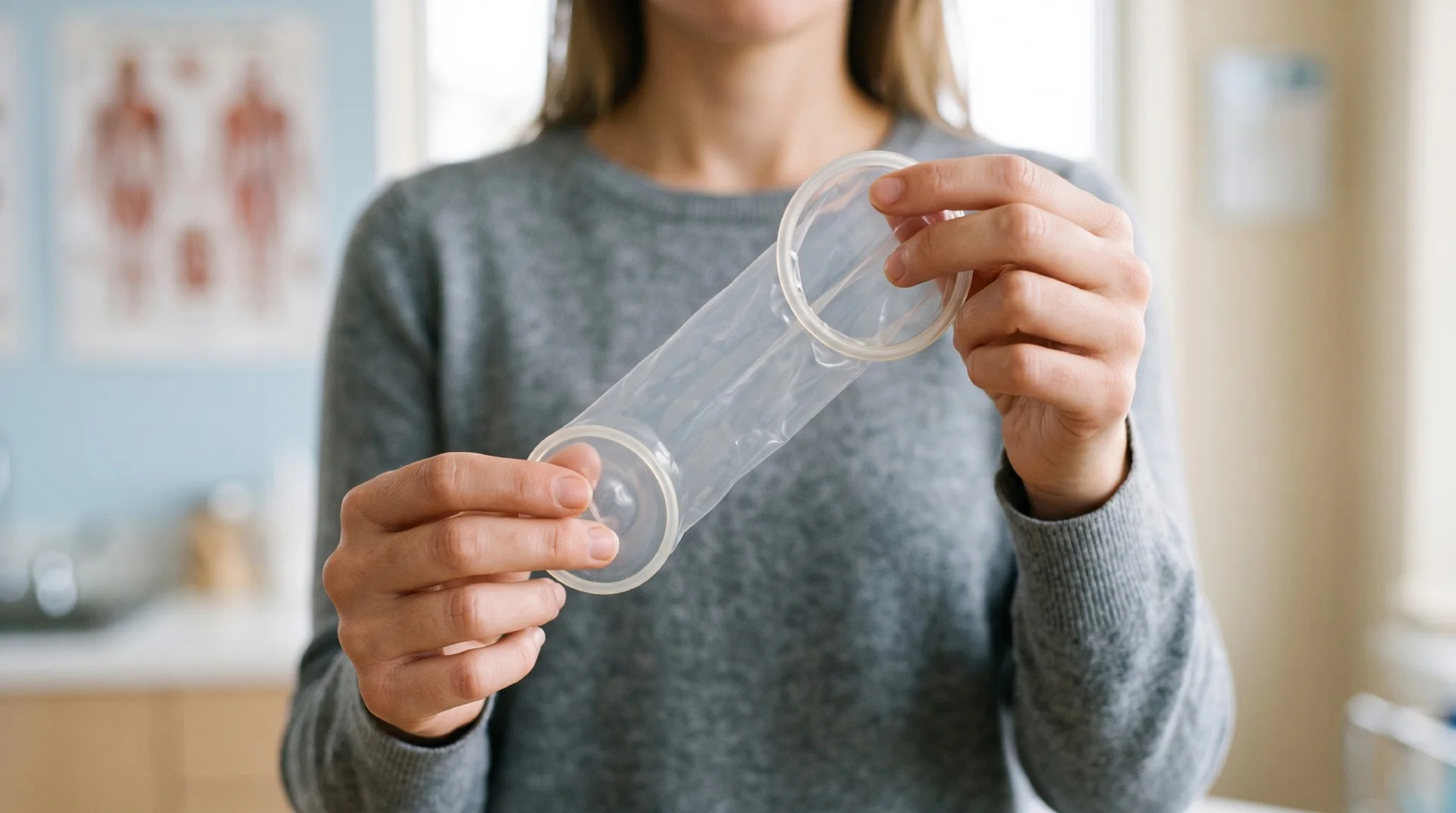
Female Condom (Internal Condom): Learn all about the female condom, what it is, how it works, benefits, use, effectiveness, and tips for safer sex and STI protection in our article below
Understanding Female Condoms
When most people hear the word condom, they picture one that is rolled over a penis. However, there is another barrier method that puts the receptive partner in control: the female condom. More commonly called an internal condom today, it offers nonhormonal protection against pregnancy and sexually transmitted infections while leaving room for spontaneity, sensation, and shared responsibility.
What Are Female Condoms?
A female condom is a soft, loose-fitting pouch worn inside the vagina during vaginal sex. It has a closed end containing a flexible inner ring and an open end surrounded by an outer ring. The inner ring helps hold the pouch in position, while the outer ring remains outside the vagina and covers part of the vulva.
Although “female condom” remains a familiar product name, “internal condom” is more inclusive. People of different sexes and gender identities may use one. The Centers for Disease Control and Prevention uses both terms and describes the device as a condom worn inside the body.
History and Development of Female Condoms
The first widely marketed modern female condom was the FC1, introduced during the early 1990s. It was made from polyurethane and offered a new way for receptive partners to participate directly in barrier protection. Its design was promising, but its material made it relatively expensive and sometimes noticeably noisy.
Development continued, leading to the FC2 Female Condom. The basic design remained similar, but softer nitrile replaced polyurethane. This helped reduce manufacturing costs while producing a quieter and more comfortable product. The U.S. Food and Drug Administration approved FC2 in 2009 for preventing pregnancy, HIV/AIDS, and other sexually transmitted infections.
The Purpose of Female Condoms
The female condom creates a physical barrier that helps keep semen and genital fluids from entering the vagina. It provides contraception without hormones and reduces exposure to infections passed through sexual fluids. Because its outer ring covers part of the external genital area, it may also offer some additional coverage compared with an external condom, although no condom completely eliminates the risk of every STI.
Types and Brands
Overview of the FC2
FC2 is the best-known internal condom in the United States. It is a single-use nitrile pouch approximately 6.5 inches long, with a flexible ring at each end. It comes pre-lubricated and can be inserted before sexual activity, so protection does not have to interrupt the moment.
Nitrile may be useful for people who avoid natural-rubber latex. Additional compatible lubricant can be added if desired, following the package guidelines. Always check the expiration date and inspect the package for defects, tears, or damage before use.
Comparison With Other Brands
Different internal condom designs have been developed or distributed internationally, including products marketed as the Woman’s Condom, Cupid, Velvet, and VA w.o.w. Availability and regulatory approval vary considerably between countries. Some designs use rings, sponges, capsules, or other features to help the condom remain in place.
FC1 is the earlier polyurethane model and has largely been replaced by FC2. Shoppers should never assume that every product sold online has been evaluated by their country’s health regulator. Look for authorized products, purchase from a reputable provider, and follow the instructions packaged with that particular brand.
Mechanisms of Action
How Female Condoms Work
Once inserted correctly, the female condom lines the vaginal canal. During vaginal sex, the penis enters the condom’s opening rather than passing between the pouch and the vaginal wall. Semen is collected inside the condom instead of entering the vagina, reducing the likelihood that sperm will reach an egg.
The barrier also reduces the exchange of fluids that may carry HIV and other infections. It contains no hormones and does not change the menstrual cycle. Protection begins when the condom is properly positioned and lasts for one act of intercourse.
Proper Use for Maximum Effectiveness
Begin by checking the expiration date and opening the package carefully. Avoid teeth, scissors, sharp nails, or jewelry that could cause tearing. Find a comfortable position, squeeze the sides of the inner ring together, and gently insert the closed end into the vagina. Use a finger to push the inner ring upward until it rests near the cervix.
Make sure the pouch is not twisted and allow the outer ring to remain outside the vaginal opening. During penetration, guide the penis into the center of the condom. Stop if the penis slips between the condom and vaginal wall, the outer ring is pushed inside, or the condom tears.
After sex, gently twist the outer ring to help contain semen, then pull the condom out slowly. Place it in the trash rather than flushing it. The CDC specifically advises using a new internal condom every time and never using an internal and external condom together, because friction between them can lead to slipping or tearing.
Contraception and STI Protection Using A Female Condom
Efficacy Against Pregnancy
With perfect use every time, internal condoms are approximately 95 percent effective at preventing pregnancy. Under typical real-life conditions, they are about 79 percent effective. That means roughly 21 out of every 100 people relying exclusively on internal condoms may become pregnant during a year of typical use.
The difference between perfect-use and typical-use efficacy highlights the importance of practice. Using the condom from beginning to end, guiding the penis into the pouch, and checking its position can improve protection. Someone who wants stronger pregnancy prevention may combine internal condoms with a compatible contraceptive method, such as the pill, implant, injection, or IUD. Ask a healthcare professional which combination is suitable for you.
Protection Against STIs
Used correctly and consistently, female condoms help reduce the risk of HIV and other sexually transmitted infections transmitted through bodily fluids. They may not completely protect against infections spread through uncovered skin, such as herpes, HPV, or syphilis.
Condoms must be used from start to finish during every sexual encounter to provide their best protection. Regular STI screening, honest communication, vaccination where available, and medical treatments such as HIV PrEP may form additional parts of a broader sexual-health plan.
User Experiences and Patient Reviews
Common Female Condom User Feedback
Positive patient reviews often mention the greater sense of control, the lack of hormones, and the ability to insert the condom before sex. Some users enjoy the looser fit compared with an external condom. Others find that the outer ring adds pleasurable stimulation around the vulva or clitoris.
Not every review is glowing. First-time users sometimes describe insertion as awkward or report that the condom feels unfamiliar. Some notice movement or sound during sex. Those concerns frequently improve with practice, communication, and additional lubricant.
Common Condom Concerns
If the female condom feels uncomfortable, check that it is not twisted and that the inner ring has been pushed fully into place. A little extra lubricant may reduce unwanted friction or noise. If the outer ring is pulled inside or the penis enters beside the pouch, stop and correct the problem.
If semen spills, the condom tears, or it is used incorrectly, contact a pharmacist or healthcare provider promptly about emergency contraception and appropriate STI testing. Do not douche, as douching cannot prevent pregnancy or infection and may irritate vaginal tissue.
Awareness and Perceptions
Findings From an Australian Survey
A 2021 Australian study examined the experiences of 284 women who were supplied with female condoms. Seventy-nine percent tried at least one of the condoms provided. Afterward, 51 percent said they would consider using the method again for STI prevention, while 40 percent would consider it again for contraception. Forty-three percent said they might recommend it to others.
These findings suggest that hands-on experience can improve familiarity, although one trial does not make the product everyone’s favorite. Comfort, partner cooperation, access, education, and confidence using the method all influence perceptions.
Knowledge and Awareness Among Women
Internal condoms remain less familiar to many people than external condoms. In a 2021 Australian study, nearly one-third of participants had not previously heard of the female condom, and fewer than half had seen an instructional demonstration before attempting to use one. Only a small proportion had learned about the method from a healthcare provider. These findings highlight the potential value of clear demonstrations, accessible information, and nonjudgmental conversations with healthcare providers when helping people decide whether an internal condom is right for them.
Advantages and Disadvantages
Benefits of Using Female Condoms
The female condom is hormone-free, controlled by the receptive partner, and capable of protecting against both pregnancy and infections. It can be inserted ahead of time and does not depend on an erection. Nitrile construction provides an option for many people with latex sensitivities. It also offers external coverage around part of the vulva and can be paired with additional lubricant.
Potential Drawbacks and Limitations
Internal condoms can cost more and may be harder to find than external condoms. Insertion has a learning curve, and the outer ring remains visible outside the body. Incorrect positioning can cause slipping, misdirection, leakage, or tearing. They are less effective against pregnancy under typical use than long-acting methods such as implants and IUDs. Most importantly, an internal condom cannot be reused or worn simultaneously with an external condom.
Availability and Accessibility
Where to Buy Female Condoms
In the United States, FC2 may be obtained through a healthcare provider, participating pharmacy, telehealth service, community health center, family-planning program, or public-health initiative. A pharmacy may need to order it even if it is not sitting on the shelf. The manufacturer also offers an online prescription pathway and mail delivery through participating services.
Availability differs internationally, so contact local health centers, sexual-health clinics, or family-planning organizations. Be cautious when buying from unfamiliar online sellers, and verify the packaging, expiration date, and regulatory status.
Cost and Insurance Coverage
The cost depends on location, pharmacy, quantity, and insurance. In the United States, FC2 may be available for little or no out-of-pocket cost with a prescription under many insurance plans, although coverage is not guaranteed and must be confirmed with the insurer or pharmacy. Uninsured and underinsured people may be able to obtain supplies through local health departments or community programs.
Expert Opinions
Insights From Jan Kaufman
Jan Kaufman, Director of Health Promotion at Washington and Lee University, presents the female condom as a nonhormonal option that protects against pregnancy and STIs. Her university health guidance emphasizes correct placement, ensuring the pouch is not twisted, and twisting the outer ring during removal to help keep semen contained.
Perspectives From Other Health Experts
Sexual-health experts generally agree that people benefit from having a range of contraceptive choices. No single option fits every body, relationship, or encounter. The female condom expands that menu by giving the receptive partner a barrier method they can place themselves. Experts also stress that access alone is not enough: people need clear instructions and an opportunity to become comfortable using the product.
FAQs
How Do I Insert and Remove a Female Condom?
Squeeze the inner ring, insert the closed end, and push the ring toward the cervix. Leave the outer ring outside the vagina and ensure the pouch is not twisted. After sex, twist the outer ring, withdraw the condom gently, and discard it in the trash.
Are Female Condoms Reusable?
No. Each female condom is designed for one-time use. Reusing it increases the risk of damage, leakage, pregnancy, and infection.
What Are Some Common Misconceptions About Female Condoms?
They cannot disappear inside the body, they do not require an erection, and they do not contain hormones. They should not be paired with an external condom. Wearing two condoms does not double protection; it may create damaging friction.
Are There Online Social Communities Discussing Female Condom Use?
Yes. Sexual-health forums, contraception communities, LGBTQ+ groups, and reproductive-health organizations discuss internal condom use online. Patient stories can be helpful, but product directions and professional medical advice are more reliable than anonymous posts.
How Do I Approach a Lover About Using a Female Condom?
Keep the conversation positive and collaborative. You might say, “I found a barrier option that gives us pregnancy and STI protection, and I’d like to try it together.” Discuss it before sexual activity, look at the instructions, and consider practicing insertion without pressure.
Conclusion
The female condom is a flexible, nonhormonal barrier that can help prevent pregnancy and reduce the risk of sexually transmitted infections. It gives the receptive partner more control, can be inserted before sex, and offers an alternative when an external condom is not preferred. Learning how to position it correctly takes a little practice, but that small investment can bring greater confidence and more options to your sexual-health routine. Whether you call it a female condom, internal condom, or FC2, it is one more useful way to protect your body while keeping pleasure, communication, and peace of mind firmly in the picture.
References:
Fenwick, S. E., Botfield, J. R., Kidman, P., McGeechan, K., & Bateson, D. (2021). Views and experiences of the female condom in Australia: An exploratory cross-sectional survey of cisgender women. PLOS ONE, 16(2), e0246664.