Editor’s Note: Explore the history of swinging, from its early origins to the modern swingers lifestyle. Discover how attitudes toward consensual non-monogamy, partner swapping, and open relationships have evolved.
Swingers: Are they all freaky, deviant predators?
This article is the first in a series exploring the history and repercussions of swinging. I want to invite you to take a voyage with me into the world of what we now call “swinging.” It is my intention to inform you, as well as to provide a better understanding of swinging, and swingers, from yesteryears to the present time.
We will examine how swinging came about in North America through the lens of changing social history. We will consider how changes in the socio-cultural ideology have led to the rise of present-day non-monogamy.
But first, what is Swinging? The History of Swinging
Swinging is a socio-sexual recreational activity in which married (or emotionally committed) couples agree to engage in sexual non-monogamy with other individuals, either together or separately. It evolved as an alternative to the societal expectations of marital “monogamy,” which dominated much of the 20th century. It includes, but not restricted to, such activities as cuckoldry, hotwifing, group sex, and it may branch into other sexual modalities, such a BDSM and other forms of Kink. All of it falls under the definition of swinging.
Perhaps worth noting that Bob McGinley, one of the most influential pioneers of the swinging lifestyle in North America, referred to swinging couples as “PlayCouples”, emphasizing the recreational aspect of the activity.
Most people wouldn’t openly discuss or challenge the status quo; quite often, discussions regarding non-monogamy, or “cheating” or “adultery”, as it was perceived then, tended to be relegated to the fringes of mainstream discourse, if addressed at all. Anyone engaging in those “forbidden activities” was disgraced, dishonoured, and “banished” forever. Lives were ruined, careers destroyed. Very much akin to what we now call being “cancelled”.
Nowadays, to make non-monogamy seem more palatable, and perhaps more ethically acceptable, the term “consensual” has been added to discussions of swinging, although swinging is already “consensual” by definition. It is, after all, an agreement between both parties in a stable committed relationship to expand their sexual frontiers to include other individuals; thus, consent is already implied, and it has always been part of swinging from the beginning. It seems to me that insisting on using the term “consensual” as a precursor is more “virtue signalling” than anything else.
It’s redundant.
Even today, there is still a failure to acknowledge the importance of swinging in the evolution of what we now consider as sexual intimacy in marriage. Further, swinging has allowed for a wider understanding of what constitutes individual sexual autonomy, and its direct contribution to the shift in more positive attitudes towards non-monogamy.
Thus, swinging could be seen as a catalyst for an evolving approach to relationships, from its early beginnings in post-war suburbs to its present open manifestation in the era of social media. We could say that it has progressed from social taboo to personal liberation, allowing for a healthier participation in the swinging lifestyle.
In future articles, I will explore further how it all started, the roots of non-monogamy and the emergence of “free” sex and love that permeated much of the early part of the 20th Century. We will explore the beginnings of what started as “wife swapping” and “key clubs” and what followed including swinger’s events.
While most people consider the 1960s as the dawn of the swinging movement, its roots predate the time when the term “swinging” was adopted (yes, the term “swinging” or “swingers” was first used in the 60s). We will explore how the early bohemian radical movement of the 1910s to 1920s and the concepts of “free love” and “free sex”, and the emergence of “petting parties” and “group sex”, eventually led to present- day swinging.
Although swinging has mostly been an activity that concerns a “couple”, singles have been introduced more and more in the last 20 years or so with mixed results (meaning, it sometimes worked, other times it didn’t work so well, but we’ll discuss this topic in later articles). Up until the early 2000s, most swingers’ clubs allowed entry only to couples.
But now, for something completely different…
“So, you’ve hung out with swingers for a long time; what are they like?”
Not long ago, a friend of mine, familiar with my lifelong research on swingers, asked me that question during one of our weekend outings at a local live music concert.
“What do you mean, what are ‘they’ like? Who are ‘they’?” I responded.
“Well, you know who I mean, the swingers, aren’t they ‘weird’? Do they have orgies all the time? I bet they can’t get enough of screwing each other? I bet the wives are sex crazed nymphos… and do they swap car keys? If you ask me, they’re all freaky, deviant predators?”
My friend’s perception of swinging and swingers isn’t much different from that of other non-swingers I have met throughout decades of research and work with this population. The idea that swinging is a never-ending orgy of sweaty bodies, weird people oozing bodily fluids, is alive and well in our society. Moreover, the idea that swinging is part of a deviant, liberal plot devised to corrupt the morals of the country and bring civilization to perdition is alive and well and far too often endorsed by the popular media as well (as well as social media nowadays…)
I have heard people equate swingers with “those weirdos that are featured on the Springer show” (for those of you of the millennial generation, look it up on Google). Further, at some point on The Dr. Phil Show, swingers were portrayed as individuals whose relationships were in shambles and had resorted to “cheating” (or swinging — a synonym apparently) as a last attempt to save a moribund marriage.
Of course, the good Dr. had a foolproof therapeutic solution for this abomination: stop at once this deviant behaviour to save the sanctity of the marriage bed: these misguided people need a therapeutic foolproof solution.
Stop at once and repent, all of you sinners.
I was initially invited to contribute to that show, but I politely declined, since I didn’t relish getting into on-air polemic discussion with the good Dr. about the virtues of social morality.
I was a guest on a talk show/podcast at a Boston, Mass., radio station just a few months ago, where the host expressed concerns not dissimilar to those expressed on Dr. Phil’s show a few years ago; it seems the more things change, the more they remain the same. Mind you, I received a far warmer reception on this show than I would have with Dr. Phil: this show evolved into a rather pleasant, and civil discussion on the topic.
In any case, let’s get back to my friend’s initial query. “Who are swingers and what are they like?”
Individuals and organizations in popular culture and scientific communities have attempted to answer that question, both with a particular bias that shapes their evaluation. Swinger-friendly reports tend to show swinging in the best light possible — popular media shows the vagaries and pitfalls of swinging, while the scientific/research community, (which has little contact with the swinging community), really doesn’t have a clue either way.
So, let me answer the question based on applied research I have conducted on the Lifestyle for the last forty years.
Firstly, swingers are just like anyone else. They are like you and me, our friends, our neighbours and co-workers, team mates or club friends: some are doctors, others are car mechanics, cops, nurses, physicians, librarians, politicians, accountants (yes, even those…), clergy and devout religious people, hairdressers and military. In a nutshell, swingers are not a special breed of individuals that display a membership mark that identifies them to others as “different”. Oh yes, there’s something that distinguishes swingers from everyone else in our society and that something is an open attitude towards relationships and sexuality in general.
And one more thing, I want to add: I would bet you know more swingers than you think you do. They don’t necessarily advertise who they are and what they chose to do in their private sexual lives or what their sexual predilections may be. As such, they do hide in plain sight, in the corners of everyday life. Mind you, some may suggest something is up by displaying an upside-down pineapple or mention something called the “Lifestyle”…
Stay tuned to Part 2 of the History of Swinging next month in Dr. Ziggy’s Swinging Paradigm!
About Dr. Ziggy

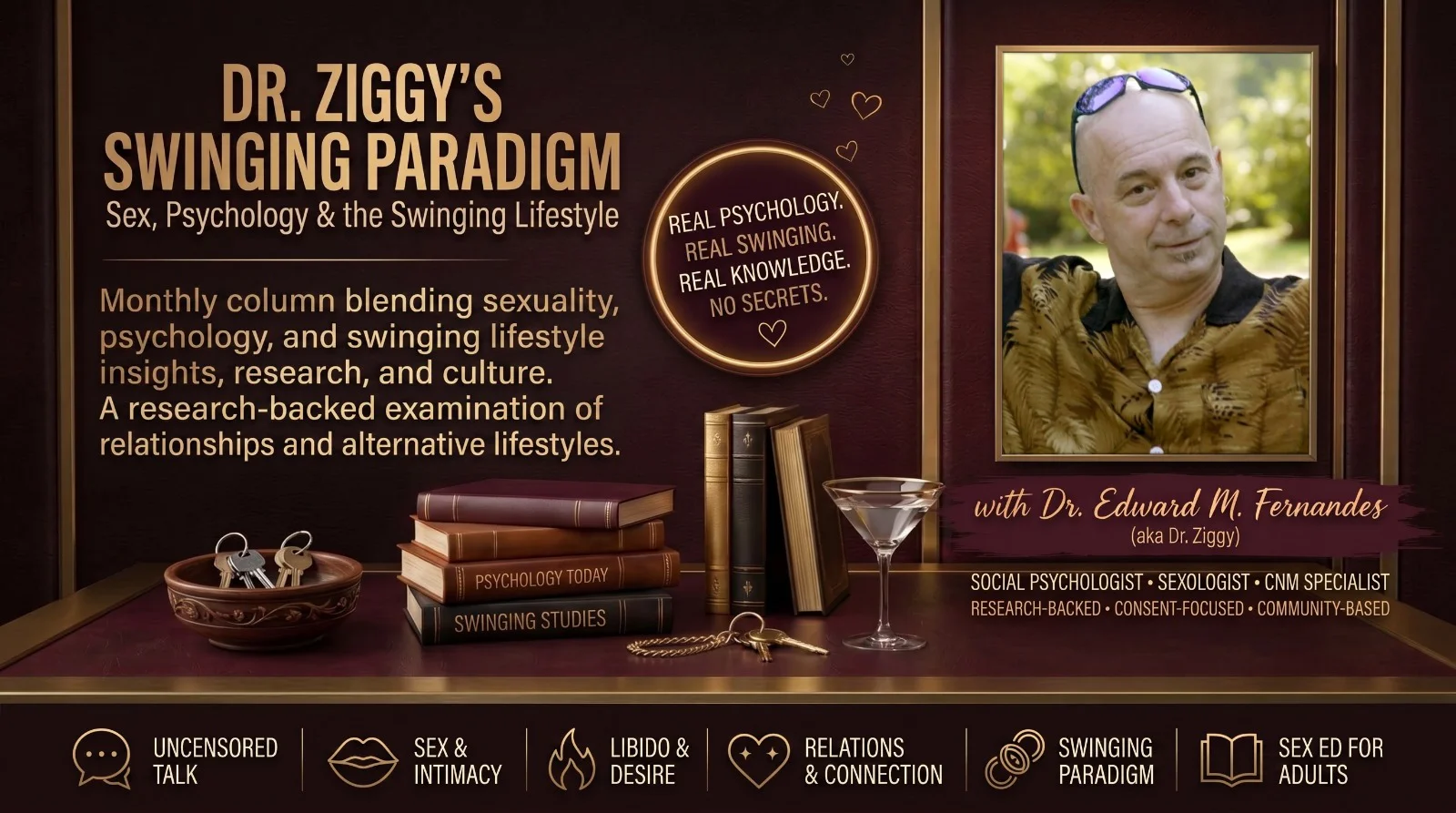
Join Dr. Ziggy for a monthly column about sexuality and topics of interest within the context of the Swinging Lifestyle, along with insights into relationships, psychology, culture, and other aspects of the Lifestyle — and beyond.
Bio:
Edward M. Fernandes, Ph.D., (aka Dr. Ziggy) is a social psychologist and sexologist specializing in sexuality, consensual non-monogamy, swinging, and open relationships. A recognized researcher in alternative lifestyles, Dr. Fernandes has published and presented research on consensual non-monogamy and sexual behaviour at major scientific conferences and has been featured in television, radio, and publications including Esquire and Self. Dr. Fernandes also facilitates workshops and speaks on sexuality and consensual non-monogamy, as well as writes about the psychology of swinging for Psychology Today and other lifestyle publications.